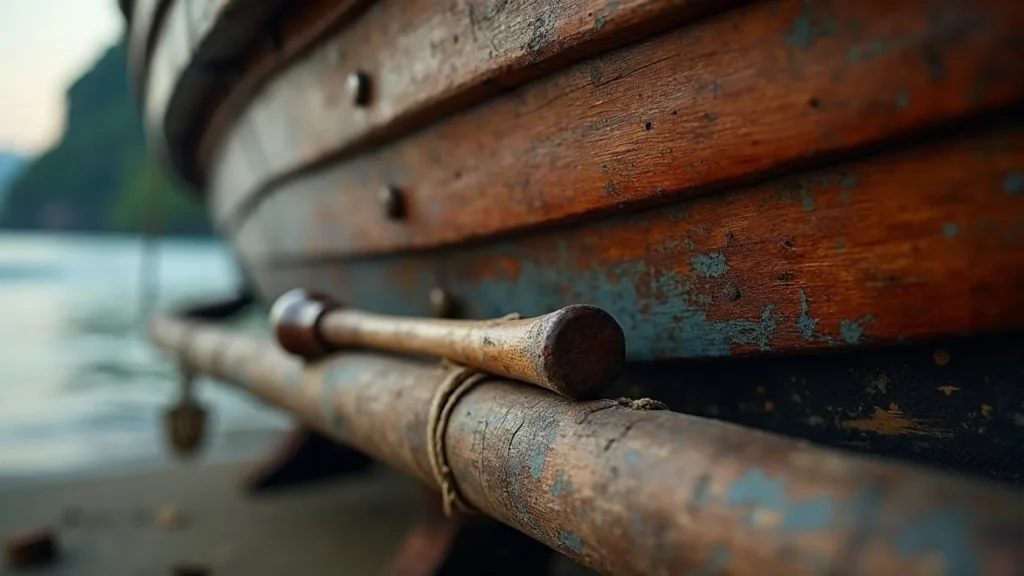
Most timber hull failure is a fastening or drainage problem before it is a plank problem. Repairs on this foreshore therefore start with the question of why a plank went soft — not with cutting it out. Replacing timber without correcting the cause produces a hull that needs the same repair, in the same place, three years later.
Diagnosis before cutting
The inspection sequence at a Bira wooden boat yard is deliberately slow at the start. Percussion sounding across the planking finds voids and softness. Probing confirms depth. Fastening samples are drawn in representative areas to judge wastage. Bilge and limber paths are traced, because standing fresh water is the most common single cause of decay in tropical timber hulls. Only then is a cut list written.
| Finding | Likely cause | Typical response |
|---|---|---|
| Soft plank ends at stem or transom | End-grain water uptake, poor drainage, wasted fastenings | Plank end or full plank renewal plus drainage correction |
| Weeping seams that will not hold | Worn plank edges, hull working, previous over-caulking | Seam preparation, edge assessment, re-caulk on sound edges only |
| Localised soft spot mid-plank | Impact damage, fastening leak, trapped fresh water | Graving piece if surrounding timber is sound |
| Frame softness at the heel | Bilge water standing against the frame foot | Sistering or frame section renewal, plus limber clearance |
| Rust staining around fastenings | Fastening wastage, sometimes with nail sickness in surrounding timber | Zonal fastening renewal, timber assessment around each |
Plank work
Plank replacement on a carvel hull is straightforward in principle and unforgiving in detail. The new plank must match the old in species and, as far as possible, in seasoning; it must land fair against its neighbours without being forced; butts must be distributed so the hull is not weakened along one line; and the fastening pattern must match what is already there or the load path changes. Where a run of planks is being replaced, the hull is supported so it does not move while the run is open — a hull that shifts while planking is out is a hull whose seams will never fully settle.
Frames, floors and fastenings
Sistering a frame — fitting a new member alongside a damaged one — is the routine repair, and it is a good one when the original frame retains real strength and the new piece can be properly fastened through to the planking. It is a poor choice when the underlying frame is soft along its whole length, because the sister then carries load through fastenings landing in decayed wood. Floors, which tie the frames across the keel and take the worst of the bilge water, are frequently in worse condition than the frames above them and are inspected as a set.
Fastening renewal by zone, not by symptom
If a sample draw shows wastage in the garboard region, the sound assumption is that the whole region is affected, not just the fastening that leaked. Zonal renewal costs more on the invoice and less over a decade.
Caulking as a system
Caulking is not a sealant applied to a leak. It is a structural system: cotton or oakum driven to a controlled depth in a prepared seam, hardening the hull and allowing the planking to work without opening. Its success depends almost entirely on the condition of the plank edges. Seams whose edges have been worn round by successive re-caulking will not hold new material properly no matter how carefully it is driven, and the honest answer in that case is edge repair or plank renewal.
The stopping over the caulking, and the paint or sheathing over that, are then chosen to suit how the vessel is used. A hull that stays afloat year-round is treated differently from one that spends months on the hard between charter seasons.
Sheathing and coatings
The decision to sheath a timber hull deserves more caution than it usually receives. Applied over dry, sound, well-fastened planking it can add years of service and simplify antifouling. Applied over timber carrying moisture, it seals that moisture in against wood that then has no opportunity to dry, and decay proceeds invisibly beneath a surface that looks perfect. Where a hull’s history is unknown, the desk’s default is to open, dry and verify before sheathing anything.
When repair stops making sense
There is a point at which replacing successive plank runs, frames and fastenings costs more than the vessel is worth and delivers a hull that is neither original nor new. Saying so is part of the job. Where that point has been reached, the conversation moves to replacement construction and the new-build supervision route rather than another season of partial repairs.
Send a repair enquiry
Photographs of the affected areas, the last survey if there is one, and a description of how the vessel is used. Diagnosis first, cut list second.
- WhatsApp: +6281139414563
- Email: bd@juaraholding.com
- Quotations: issued in USD after a written scope and a hull inspection.