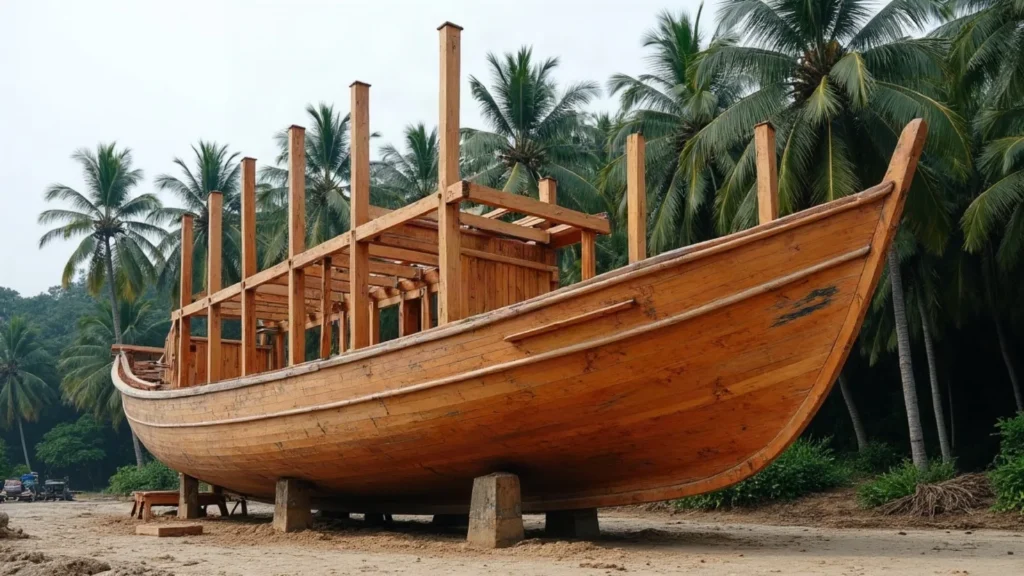
New-build supervision is the owner’s side of the table. The yard team builds; the desk specifies, inspects, records and gates the money. On the Bira foreshore, where construction runs on deep craft knowledge and light paperwork, that division of labour is what turns a good hull into a defensible project.
What supervision actually delivers
A written build spec
Scantlings, species, fastening schedule, joinery standard and systems layout agreed before the keel is laid, in language both the owner and the yard team can work from.
Timber acceptance
Stock inspected and accepted or rejected on arrival — species, grain, seasoning, sap, checks and dimensions — because rejecting timber costs a delay and replacing planking costs a season.
Dated photographic record
Fixed-position photography at each milestone, so structure that will be permanently hidden is documented while it is still visible.
Payment gates
Stage payments released against verified milestones with written acceptance criteria, not against elapsed calendar time.
Milestones that mean something
A milestone is only useful if it can be inspected and failed. “Fifty per cent complete” cannot. The gates used on a supervised timber build are physical states:
- Keel, stem and sternpostTimber accepted, scarphs cut and closed, centreline true and recorded.
- Frames erected and fairedFrame spacing, bevels and fairness checked against the lines before planking begins.
- Planking closedPlank runs, fastening pattern, butt distribution and seam preparation recorded plank by plank in the areas that matter.
- Deck structureBeams, carlins, knees and deck fastening complete and inspected before the deck is covered.
- Systems rough-inEngine bed, shaft line, tank foundations, bonding and cable routes fixed before joinery closes access.
- Joinery and finishInterior fit-out, coatings and detail against the agreed standard.
- Launch, trials and handoverTake-up monitoring, alignment check under load, systems commissioning and a complete build record.
The hidden-structure problem
Once a hull is planked and ceiled, most of what determines its thirty-year life is invisible. Fastening pattern, floor fitting, limber drainage, frame-to-plank bearing and the treatment of end grain at stem and transom are all decided early and inspected never — unless someone photographs them while they are open. This is the single highest-value function of supervision, and it costs almost nothing at the time.
Drainage decides longevity
Timber hulls in the tropics rarely fail from load. They fail where fresh water sits and cannot drain — behind ceiling, under sole bearers, at the heads of floors, in the ends. A build supervised with drainage in mind ages very differently from one that was not.
Where supervision fits the wider programme
A supervised build at Bira is one part of a longer chain: design, construction, commissioning, management, then years of repair and refit. Owners planning across that whole arc are usually best served coordinating the construction stage against the supervised new-build programme, while keeping local yard execution and inspection where the timber and the labour actually are.
Once the vessel is afloat, the same discipline carries into the maintenance cycle — the first haul-out, the first survey and the first real refit are described under haul-out and slipway and refit and restoration.
What supervision cannot fix
It cannot make an underpriced build succeed. If a budget assumes timber and labour rates that do not exist, supervision will surface that early — which is useful — but it will not conjure the difference. It also cannot substitute for an owner making decisions. Builds stall most often not at the saw but at the desk, waiting for a layout choice or an engine selection that only the owner can make.
Discuss a supervised build
Send the concept, intended use, target dimensions and timeline. The first output is a realistic specification and milestone schedule, not a brochure.
- WhatsApp: +6281139414563
- Email: bd@juaraholding.com
- Quotations: issued in USD after a written scope and a hull inspection.